

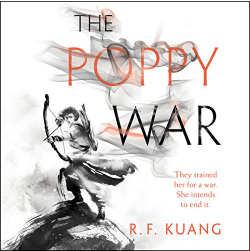
This book is incredible. I cannot stress enough how underrated it feels, and that it took me so long to find. Dealing with some of the darkest and bloodiest events in Chinese history – the Second Sino-Japanese War and also the Rape of Nanking (two events that are largely ignored in the American history curriculum) – the book is DARK. Very dark. Seriously, the author does not pull any punches when it comes to describing brutal and violent scenes, but never for the sake of just describing violence. These scenes are instrumental in shaping the world the characters live in, and ultimately in shaping their development.
I read this book as part of a (different) book club, and we had to start the next book immediately after (which we are still currently reading). At first I didn’t think I was going to like it: the beginning felt so long (part I is roughly 40% of the book). It set itself up as a YA fantasy school story, but it is very much not this. All at once, you are thrust into the midst of a war and the plot never slows down to let you catch your breath.
The story starts in Rooster Province (each of the twelve provinces are named after the Chinese Zodiac) where our main protagonist Rin passes the Keju and wins her way into Sinegard – to everyone’s surprise. As a poor peasant girl from the south, Sinegard is not made easy for her. Between her darker skin, her poverty, and being a female, Rin’s classmates (wealthy and privileged heirs of Warlords) make life miserable, forcing her to prove to herself, and everyone else, that she belongs there.
~SPOILERS AHEAD~
Despite its length, Part I is crucial for world building, and for establishing character relationships. After getting into the most elite military school, Rin must compete in Academic and military style trials to secure her continued spot at Sinegard. One of the Masters must choose her as an apprentice, or she will be sent back to the south where she will be forced to marry a man much older than herself.
Faced with the prospect of a monthly period, she swallowed a poison that is meant to destroy her uterus. She can no longer have children, a fact that would ruin even her bleakest prospects of being chosen by the wealthy older man. (This part is small, but it really stuck with me. I love when books don’t ignore real world issues for the characters, and this book definitely does not. But it even takes it one step further to grapple with the roles of females in war and how biology can get in the way of this. This is one of the more headstrong decisions Rin makes, and she does it so quickly and barely looks back, in a way that allows the reader to really have to sit back and think about the consequences.)
Thankfully, she learns that she has a Shamanic power and is chosen by Jiang, Master of Lore.
She is warned that this is a futile prospect, the Lore is a joke, and is also chosen by the Master of Strategy. But Rin felt the fire, and it almost destroyed her. She is impatient and stubborn and training with the Master of Lore does not quell her need for power. Her connection to the vengeful Phoenix drives her own need for vengeance, something she is offered when the Federation of Mugen invades.
“War doesn’t determine who’s right. War determines who remains.”
Rin finds herself assigned to the Cike – a collection of odd shamans who are more or less on the brink of losing their minds to their gods – and their fearless leader Altan Trengsin. Under him, she learns the power that can be found in true rage and hatred, and fuels the fire within her. She learns that she is Speerly, one of the last descendants from the destroyed island of Speer. She fights in their honor, so that her country is never again brought to its knees by the Mugenese.
She is faced with impossible choices, many of which result in unforgivable consequences.
Summing up this book does it a disservice. The amount of plot R.F. Kuang is able to unfold in just this first book is the amount other epic fantasies would spread over a trilogy, and she does it in a clever and well-written way so that the reader never feels like it is rushed. Her exploration of setting and the amount of Chinese culture she makes feel natural on the page helps bring the book to life, while at the same time serving as a reminder that our own world can be a horrifically cruel place. Her magic system is based on communion with gods but also on drug use in a way that is intricate and complex. Her cast of characters are richly developed and multidimensional, crafted in a way that brings the reader pain when they are in pain. Everything Rin was, everything she’s become, grew out of the carnage of her people. Anger and rage drove her will and her ruthless choices and her character arc felt vital and developed. This book has everything, and I cannot wait to read the rest of the trilogy.
The book is heartbreaking, but it is also thoroughly satisfying and one of the best fantasy books I have read in a long time!
 emilyjaneestabrook.com
Leave a comment