

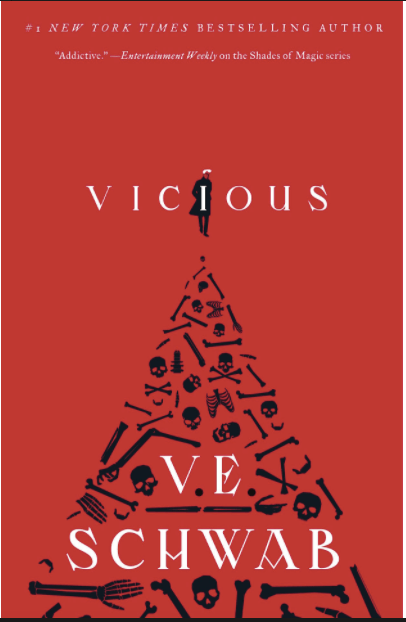
I read this book as part of a book club that wanted to break apart how to craft tension. VE Schwab does it masterfully. The writing was addictive, I still don’t know which character I was supposed to be rooting for (maybe none of them), and the world was portrayed so naturally that the book was able to jump over a ten year span flawlessly.
Eli and Victor were roommates at Lockland University ten years ago. They were brilliant, and arrogant, and recognized the monster that crawled beneath the other’s skin. Their senior research thesis led to an experiment-gone-wrong: the creation of ExtraOrdinaries via near-death experiences.
Ten years in the future (the present for the novel), the book opens with Victor digging up a body in a cemetery with a young girl he saved from the side of the road. As fate would have it, the girl had been shot by his now nemesis Eli. Eli is on a mission to eradicate all EOs with a god-complex and the young girl’s compelling sister. The two draw closer and closer together, and the book keeps you on the edge of your seat to its gripping end.
— BOOK CLUB QUESTIONS (SPOILERS AHEAD) —
My book club wanted to dig into how the book gripped you. Our fearless leader Jenni Meade (I recommend reading everything she writes!) set us up with some hard-hitting questions to get to the bottom of it.
1.) Schwab says the most difficult parts of writing Vicious were making craft invisible and creating the actual logic of the superpowers. Let’s talk about logic of world-building—what is the logic behind her superpowers, and why does it work? How can you extend that need for real world logic to your own novel?
This stresses the importance of setting rules with magic systems: logical rules that cannot be broken. EOs power was meant to be related to their NDE – Victor could control pain, turning the dial up or down similar to the dial of pain that almost killed him. Eli could regenerate and heal himself (still a little unsure how this related to his death in the bathtub, but ties to his god-complex). Sydney could bring back the dead, similar to how she tried to bring Serena back to her as she drowned. Similar to Eli, I do not understand the logic of Serena’s gift, but she could compel anyone to do anything she told them. Dominic could travel between shadows, dulling the world around him. While Schwab said she followed logical rules, some are not as obvious as others, though the need for rules in magic systems remains. So I think the take away for me was to set some hard and fast rules. Things feel like they have some sort of logic, and once you have that you can be more forgiving to allow the more fantastical elements without needing to explain them. The rules give a sort of believable foundation. But this remains incredibly difficult, because you need to avoid just exposition explaining the rules. It needs to be woven in (invisible craft); discovered alongside the MC, dialogue and playing character situations to get the expeditionary dialogue (ie newcomer paired with expert). Schwab wove explanation into flashbacks, giving just enough information to keep us wanting more. She used a science experiment to have the MCs figure out the logic, offering an opportunity to explain without inundating us. It is extremely clever, and it makes you wonder how much of this needs to be addressed in revision and how much is naturally woven in.
Ignoring rules completely, you fall into the Deus Ex Machina effect. Sanderson sums it up best with his laws of magic.
All of this can be applied to my own writing, which was the point of trying to break down a book for craft. I want a magic system that makes sense, but still provides a sense of mystery and wonder. I do not want it to be the thing my characters reach for to solve every problem thrown their way (how boring!) I want to use a softer magic that makes the world feel larger and more eternal than the characters in it: use the magic to create problems, not solve them. This is a soft magic in comparison to Schwab’s hard magic system, and both are used to create different moods and either solve or create problems. It is helpful to ask yourself why characters have the powers they do, what triggers them, and what consequences this leads to.
In my untitled piece, the more nature-like clan has a certain magic that connects them to the world around them. It was meant to give them a connection to the environment, a strength that could help save them, but instead makes them targets of violence and war. I am still working out this magic system, and what defines the type of magic the characters have and why they have it, and will need to define some logical rules before allowing the characters to use the magic to solve anything.
In my Crooked Faith book, the world itself has a sense of magic, and some of the characters are more attuned to it than others. All the sources of magic are explained by myths and rituals, and different faiths have different abilities based on their faith. It is never defined outside the connection to faith, and it is not something that is used to solve problems.
2.) Invisible craft—Vicious takes place over a ten-year time span with five POVs and fluctuating chronology. Why does it read like a seamless story? *Because Schwab is a genius is not an acceptable answer here.
While Schwab is a genius, there are a few reasons why she is able to seamlessly jump all over time and to still feel like a chronological book. Schwab does a great job getting the reader to ask a question in a present chapter, and then immediately answering it in the flashback. Since the characters (and by proxy, the readers) are thinking about the event or a character, when she jumps back in time, it doesn’t feel like it interrupts the story. For example, Victor stares in the mirror at the bullet wound scars. Then we jump to the past and answer where those scars came from – but, we are also presented with new questions. Constantly keeping the reader on their toes and dragging them through the novel continuously asking questions, is extremely effective.
Another important piece (beyond time-stamping the beginning of the chapters), is that Schwab keeps her settings really simple and localized. I think by keeping setting at either the university or Merit (for the most part) allowed her to have a more consistent story because even if you missed the chapter heading, it was easier to tell where they were in time by knowing where they were located in setting. If she had changed up setting and the time jumps that may have been too confusing for readers. By choosing to divide the setting into two places (for the most part) and identify each with a time period, she’s given us an almost automatic source of being grounded
3.) Let’s talk about tension. All books should have it—it’s the force that keeps readers turning pages. How does this book compare to others you’ve read that are classic examples of high tension? (Six of Crows, for example, or a horror novel)
This book starts with the tension right in the beginning: “He’d just broken out of jail. She’d just been shot.” It only gets more tense from there. The whole first section of the book was compelling, but not necessarily suspenseful. She took an interesting concept, and put in some backstory and built character relationships. VES is able to build a power system, sets the characters up as enemies in the present, but drawn to each other in a way that you know something is going to break. But since this book jumped into the future, it was clear to the reader that everyone lived. This lowered some of the stakes. However, as the story progressed to the present, and Eli and Victor began to get closer in proximity, this raises some of the suspense and by extension tension, because the stakes are higher — someone could die. Because all of the powers were so unique, and seemingly impossible to beat, it became just as impossible to predict how the ending would play out. By playing the past and present storyline against each other, the reader was left waiting for the explosive moment when they would converge.
Schwab uses all elements in her story to create tension: the setting, the characters and the mood. By setting Eli up as a character who cannot be killed and Victor on a quest to kill him, you already create this really tense dynamic. She also makes it difficult to determine who is the “protagonist or hero”. Both are sociopathic and hard to empathize with, but she gives Victor just enough to make him a killer you’d root for. She uses other character’s to garner sympathy; by having Sydney and Mitch like Victor, there MUST be something redeemable about him. The setting has its own atmospheric tension, but she leverages the proximity of the characters to raise the tension. Converging on an abandoned lot definitely set the mood. And Victor sets a timeline, so the entire story is just waiting for midnight to strike.
Then, to top it all off, VES purposefully layers in moments of spikes in tension. She keeps you on the edge of your seat, then all of a sudden will drop the ground out from under you. One of my favorite moments was when Sydney (one of the only characters in the story to have any sympathy for) is in the hotel room burning papers and Serena was in the hotel. Or, when Serena thinks she is making Mitch shoot himself. Schwab is stingy in giving the reader characters to care about, and by threatening them, she pulls at your heartstrings.
Overall, I HIGHLY recommend this book, and cannot wait to apply some of the lessons I’ve learned to my own writing. I am also super excited because one of my characters is a sociopathic serial killer, and I can definitely take some notes of Schwab’s characters.
 emilyjaneestabrook.com
Leave a comment