

I probably should save the best for last, but unfortunately, outlining is pretty integral to drafting. THIS IS MY FAVORITE PART OF DRAFTING A STORY. I am a hardcore plotter in the plotter vs. pantser debate. This entire post may be incredibly irrelevant to pantsers, but I think even the most limited outline can be helpful for everyone.
THERE ARE SO MANY WAYS TO OUTLINE.
This is probably the part of the process that is the most creative in terms of structure and depth. I could write many, many posts about different outlining processes that may work for different people. Instead, I’m going to post about my outlining process, and then post some links to some different outlining processes to explore at different points.
In the end, it is completely up to each individual author how they want to outline (or not outline), and it is all about finding the way that works best and makes drafting easier (because it is HARD, so everything helps!)
MY PROCESS:
1.) Write out the idea that sparked the creativity in the first place
– This idea can be insanely helpful later if you are feeling uninspired. OR, it could be completely irrelevant to the direction the story took, but an interesting reminder of why you began in the first place.
– It does not need to be detailed, only a couple of words, or a piece of dialogue, or even a character. I need to put it down so I am not looking at a blank page, and once it is there, the words start flowing.
> example: For my untitled book, I started with the idea of the decline of civilizations and desertification. My chiropractor short story started with horrible back puns. My epic started with the shadowed outline of a man sitting in a chair watching a girl sleep (very “Twilight” feels, and it has come A LONG WAY from this point – the original idea doesn’t matter, it just needs to spark all the rest!).
2.) Decide the genre or the mood, something that will ground the rest of the ideas
– Ultimately, you want your story to make your audience feel something. If you decide what that feeling is early, it is much easier to sift through all the ideas and narrow down focus on the one’s that are subservient to this feeling.
– I would highly recommend Maggie Stiefvater’s seminar. She is one of my favorite authors, and honestly, you can learn so much from this course she offers. Anyway, she is incredible at creating moods, and talks A LOT about them and why they are important.
> example: For my untitled novel, at its heart, it is a romance. I want it to do more than that though, and be comment on progress, but at its core, it’s a bittersweet love story. The #shortstorychallenge2021 gives you a genre, which is helpful in focusing the piece. Whether writing horror, comedy, action/thriller, or fantastical quests, if you know this information up front, it does a lot of the heavy lifting with decision-making.
3.) Setting
– I LOVE setting. I LOVE world-building and all of the questions and things to think about. I also fall prey to spending too much time researching, sometimes information I will never need for the story at all. My new trick for this has been to figure out the basic ideas of the setting up front, and DO NO RESEARCH. I pick a period in time, and I open up A LOT of links and save them in a folder on my toolbar. As I write the first draft, I [bracket] areas that are going to require further research.
– However, I do start to think about different pieces of the world and important questions to ask. I write these out, and some initial ideas about things like: politics, economy, infrastructure, religion, history, geography. Usually, this will open up further areas of research (and I may add some more links to my toolbar folder), but in the end, I still do not do the research at this stage.
– I think the Reedsy Worldbuilding Tool is an awesome free resource to start asking the right questions. I think any question that leads to further questions are avenues worth noting. I also think it is really important to start to try and find some pictures that match the world you are trying to build. These will be extremely helpful when writing descriptions of the scenes you are working on.
4.) Character
– At the early outlining stage, I think it is important to have a rough idea of your characters. I think you discover a lot about their motives and their voice as you write and spend time in their heads. But, it is important to make sure your characters balance each other. I like to write books with many POVs (my epic has about eight). So I need to make sure to do the work upfront and know that each character offers something different. If every character was a broody sarcastic one, then they would lose their novelty (even though they tend to be some of the best characters!)
– I think it is also important at this stage to have a general idea of what your character wants. If you don’t have a character struggling to get something, then you do not have a story.
5.) Plot points
– This is the heart of the outline: figuring out some of the events that are going to drive the story.
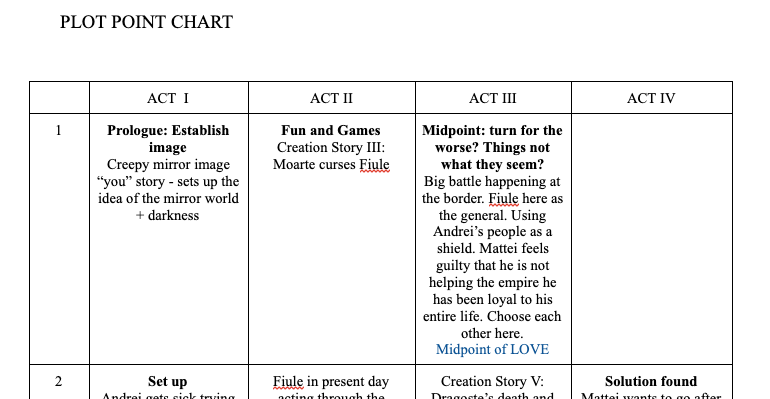
– I like to organize this into a chart (you can see a little preview of the one I used for my untitled novel in the featured image). The reason this type of chart works for me, is that each of the events lends itself to a chapter. I can mark off rising tension, midpoint, dark night of the soul, resolutions to make sure I am hitting all of the beats – and I can set it up so that I hit both external and internal beats.
– These can really take any form, even a brief bulleted list of some events you think will be important to the plot of your story. Having a list gives you a place to pull from when you are drafting a scene and staring at a blank page.
> example: Save the Cat sets up an outline that is really helpful to think about all of the beats, Romancing the Beat does this from a more internal, romance point of view. Brandon Sanderson breaks his plot points into more of a scaffolding as it develops, and this allows him to write fewer drafts. Again, there are so many different ways to do it, but for me, it is very important to know how I want the book to end before I even begin.
This is just a very brief outline of my outline (yes, I outline my outlines). I expand further on each of these points before I do any form of drafting. In fact, my outline tends to turn into a draft zero, and makes the rest of the drafting process SIGNIFICANTLY easier for me.
NEXT UP: I’ll go into much more depth on each of these pieces, and include some practicals that I like to do for each before I begin my more detailed chapter outline.
 emilyjaneestabrook.com
Leave a comment